
Review · ANGKOR WAT TOURS
Angkor Wat Temples & Tonle Sap Lake Private Day Tour
Angkor feels ancient, until you see the lake. This day tour links UNESCO Angkor highlights with real-life Cambodia on Tonlé Sap, using an English-speaking guide and air-conditioned transport so you can stay comfortable through the heat. It is a smart way to see two very different sides of Siem Reap in one go.
I especially like the guided temple explanations and the chance to slow down on the water at Kompong Phluk. The main drawback is cost clarity, the $79 tour price does not include the required Angkor Pass, which is $37 per person paid at the ticket office.
In This Review
- Key highlights you will feel right away
- A 7-hour Angkor Wat and Tonlé Sap day that moves fast, but in a good way
- Morning pickup and the Angkor Pass stop you should plan for
- Angkor Wat: the Suryavarman II masterpiece and why it still matters
- Angkor Thom South Gate: demons, gods, and the entrance you will remember
- Bayon Temple: the faces of Jayavarman VII and the maze feeling
- Lunch break and how to time it for a smooth boat ride
- Kompong Phluk floating village and Tonlé Sap boat ride: seeing a living floodplain
- What makes the guide work matter, especially for Angkor plus Tonlé Sap
- Value check: $79 tour price, plus the Angkor Pass reality
- Clothing rules and small comfort tips that save headaches
- Who should book this Angkor and Tonlé Sap day tour
- Should you book this tour?
- FAQ
- Do I need to buy the Angkor Pass for this tour?
- Is lunch included?
- What is included in the price?
- What is not included?
- What should I wear to the temples?
- Can I cancel and get a full refund?
Key highlights you will feel right away
- Early start with hotel pickup so you waste less time organizing the day on your own
- English-speaking guide who connects Khmer architecture to the stories carved on the stone
- Angkor Wat plus Angkor Thom and Bayon in one tight route, without hopping between vendors
- Boat ride to Tonlé Sap with a look at life around the floodplain, including schools and community buildings
- Cold bottled water and air-conditioned transfers, which matters when the temples are hot
- Small group size (max 10), which helps keep the experience more personal than big buses
A 7-hour Angkor Wat and Tonlé Sap day that moves fast, but in a good way
This is the kind of day trip I like when you have limited time in Siem Reap but still want more than a temple photo run. You are looking at about 7 hours total, with morning pickup starting between 7:30 and 8:30am, then a full circuit through Angkor before you shift to the lake life of Tonlé Sap.
The tour calls itself private, but it is still set up with shared vehicle time and a shared boat ride, capped at 10 travelers. That usually means you still get a real guide and a coordinated route, while keeping costs reasonable.
You will also get practical comfort touches built in. Expect air-conditioned transfers and cold bottled water, plus an English-speaking guide who keeps the day understandable, not just a series of monument stops.
More Angkor Wat tours in Siem Reap:
- Angkor Wat Sunrise or Sunset Tour with Guide from Siem Reap
★ 5.0 · 12,109 reviews - Siem Reap: Angkor Wat: Small-Group Sunrise or Sunset Tour
★ 5.0 · 9,444 reviews - Siem Reap: Angkor Wat 2-Day Tour with Sunrise and Sunset
★ 4.9 · 4,429 reviews
Morning pickup and the Angkor Pass stop you should plan for
The day begins with hotel pickup from 7:30–8:30am in an air-conditioned vehicle. You then head to the Angkor Wat Ticket Office, where you pay for the Angkor Pass that is required for temple access.
Here is the key value point: the tour price you see, $79 per person, is only part of what you pay for the day. The Angkor Pass is an extra $37 per person, and it is required. I recommend you treat your all-in budget as closer to $116 per person once you add the pass.
Also, this is not a “walk up and figure it out” situation. Your guide handles the route and timing so you are not guessing where to go first. That is a big deal on Angkor days, because the system around admissions can be confusing if you are doing it alone.
Angkor Wat: the Suryavarman II masterpiece and why it still matters
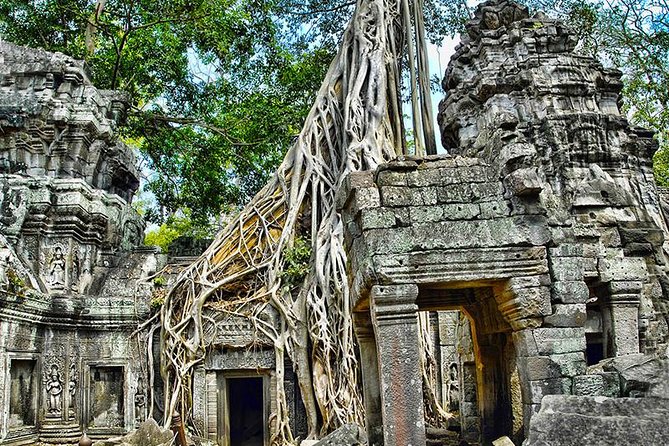
Angkor Wat is not just the most famous Angkor temple, it is also the most preserved. Your visit gets about 2 hours here, which is enough time to see the major angles and get your bearings before the heat really stacks up.
You will be learning as you go. Angkor Wat was built in the early 12th century for King Suryavarman II as a state temple and capital-city complex. It is huge in scale, and it also has a distinct spiritual message: the design represents Mount Meru, using moats and layered galleries to create a journey toward the center.
One of the most interesting things to notice is the temple’s religious shift over time. It began as Hindu, dedicated to Vishnu, then later became Buddhist while remaining a major religious site. Your guide’s job is to help you read that story in the stone, from the carvings to the layout.
The possible drawback is simple: 2 hours sounds long, but Angkor Wat is so big and so detailed that you will not see everything like you could on multiple visits. If you like slow, super deep observation, you may feel a little “hit the top highlights and move on” pace. If you want a strong overview with context, this timing works.
Angkor Thom South Gate: demons, gods, and the entrance you will remember
Next comes Angkor Thom, the fortified city that covers a large area. You enter from the South Gate, crossing a causeway lined with statues of demons and gods. These figures are carrying a giant naga, a snake-like deity, which gives the gate an almost dramatic, theatrical entrance feel.
This stop gets about 30 minutes. That is short, but it matches what most people need here: take in the doorway and the causeway details, get your photos from the right spots, and then keep moving so you can reach the next temple before the day starts to feel too grindy.
If you are sensitive to crowds, know this route is one of the most popular. Even with a small group, you may still share space with other visitors because Angkor is simply that famous. Your guide can help you plan where to look first so you are not stuck staring over shoulders.
More floating village trips in Siem Reap:
- From Siem Reap: Kampong Phluk Floating Village Tour by Boat
★ 4.9 · 6,979 reviews - Sunset tour of Kampong Phluk stilts home village on the Tonle Sap
★ 5.0 · 4,865 reviews - Siem Reap: Kampong Phluk Floating Village Tour with Boat
★ 4.9 · 3,843 reviews - Siem Reap Floating Village Kampong Phluk Sunset with Boat
★ 5.0 · 1,962 reviews
Bayon Temple: the faces of Jayavarman VII and the maze feeling
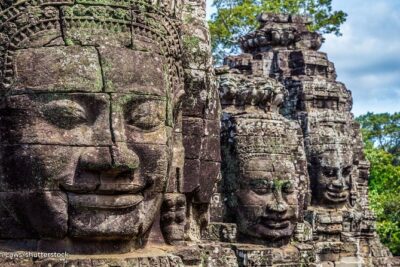
Bayon is where Angkor Thom’s spiritual world turns visual. It was built at the end of the 12th century or early 13th century as the state temple of the Mahayana Buddhist King Jayavarman VII.
Your time here is about 45 minutes. The layout is fascinating because Bayon does not have an enclosing wall of its own, relying on the city wall around Angkor Thom for protection. The main structure is organized in levels, with square galleries and then a central sanctuary.
Here is what I think makes Bayon especially rewarding for a guided day: it is easier to understand when someone explains the plan while you are standing in it. You can follow bas-reliefs across levels and grasp the “maze of galleries” feeling without getting lost or spending your time just wandering.
Also watch how the temple’s theme shifts from earlier Angkor design. Seeing the Hindu-to-Buddhist timeline in the temples around you can really make the site feel like a living timeline instead of a frozen museum.
Lunch break and how to time it for a smooth boat ride
After Bayon, you get a lunch break on your own. The tour does not include food, so you will want to pick something simple and quick, then keep your water handy.
This matters because after lunch you are driving about 45 minutes toward the countryside to reach the quay. From there, the Tonlé Sap part of the day starts, and once you are on the water, you want to be ready for the rhythm of a boat schedule.
If you tend to get sluggish after meals, I suggest choosing lunch that is lighter rather than heavy. You do not want to feel tired for the lake portion, since that is where the day becomes more about everyday life than stone monuments.
Kompong Phluk floating village and Tonlé Sap boat ride: seeing a living floodplain
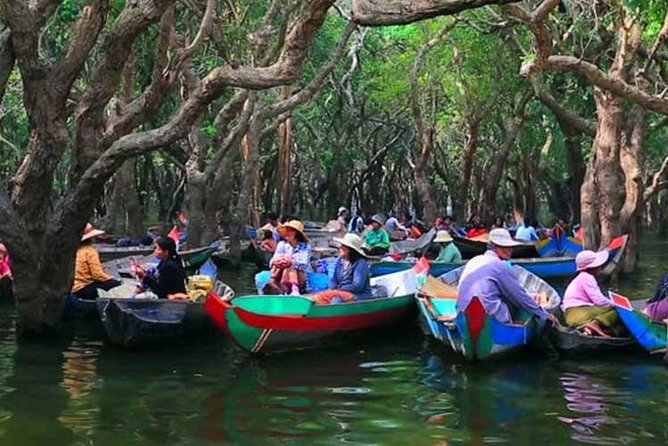
This is the heart of what makes the tour feel different from a standard Angkor-only day. After arriving at the quay, you board a local boat for about 1.5 hours.
Along the way, you pass Kompong Phluk, a floating village with homes on stilts. Its name is often described as meaning harbor of the tusks, and your guide can put that detail into local context while you watch the village layout from the water.
Your time here is designed around observation. You will see colorful houses, schools, temples, church, and local government offices. It is not just a scenic stop. It is a look at how people adapt to their environment and make daily routines work around the lake and its floodplains.
In rainy season, there is also a special visual bonus: the surrounding floodplain can turn into a green flooded forest, which changes the feel of the whole horizon.
One practical note: the itinerary mentions a canoe ride in the mangrove forest in rainy season, but it is not included. If you are traveling during the wet months and you want that extra wildlife and waterway experience, you may need to plan for it separately.
What makes the guide work matter, especially for Angkor plus Tonlé Sap
A great guide does two things on a day like this. They translate the carvings and layout at Angkor into human stories, and they help you connect what you see on the lake to how people actually live.
The good news here is that the English guide experience seems to be a strong point. If your guide is Phearom (you might see this name attached to English-language tours), expect clear explanations and steady, calm handling of the day. One of the standout themes in the guide feedback is that the guidance is not just facts, it is care and organization, especially when guests have extra needs.
For you, that means the temples are easier to enjoy. Instead of just looking at carvings and guessing what you are seeing, you can follow a story as you walk through the complex.
Value check: $79 tour price, plus the Angkor Pass reality
Let’s do the math with your decision in mind.
- Tour price: $79 per person
- Required entrance: Angkor Pass $37 per person
That puts your Angkor-day baseline near $116 per person, before any lunch you buy on your own.
What you get for that price is more than entry tickets. You get hotel pickup and drop-off, air-conditioned transfers, an English-speaking guide, temple time across Angkor Wat, Angkor Thom, and Bayon, and a shared boat trip that takes you onto Tonlé Sap and past Kompong Phluk.
If you tried to build this yourself, you would likely spend time coordinating transport and separate guides for temples and the lake. Even when prices for individual pieces can look similar, the headache factor is real. This tour gives you one plan, one guide voice, and less friction.
The one trade-off is the pace. This route covers a lot of ground in one day, so it is not for people who want to linger for hours in one courtyard. If you like a short but well-explained circuit, it is good value. If you want a slow, deep study of the carvings, you may prefer splitting Angkor into separate visits.
Clothing rules and small comfort tips that save headaches
Angkor temples have rules, and you do not want to find out mid-morning. Plan to wear trousers or a knee-length skirt or dress. That is the requirement noted for this tour.
Also consider sun and humidity. Even with air-conditioned rides, you are outside at Angkor and walking around stone surfaces. The tour includes cold bottled water, which is a real help when it is hot.
Comfort-wise, aim for lightweight clothing that still meets the coverage rule. And if you have knee sensitivities, expect some walking on uneven terrain.
Finally, a practical expectation: the tour asks for moderate physical fitness level. That does not mean you need to be a marathon runner, but you should be comfortable walking and standing for temple viewing and boat boarding.
Who should book this Angkor and Tonlé Sap day tour
This is a strong fit if you:
- Have a short stay in Siem Reap and want both Angkor and the lake in one day
- Like guided context, especially for Angkor Wat and Bayon
- Want an organized boat trip to Kompong Phluk instead of piecing together transport yourself
- Appreciate air-conditioned comfort and bottled water on a hot day
It may not be your best match if you:
- Want a slow, unhurried Angkor experience with lots of off-route wandering time
- Are hoping food is included (lunch is on your own)
- Want extra activities like a mangrove canoe ride without planning for extra cost (it is not included)
Should you book this tour?
Yes, book it if your priority is a well-paced Angkor plus Tonlé Sap day with an English guide, pickup, and the boat ride to Kompong Phluk. The balance is the big win here. You see major temples with a story you can follow, then you switch to daily life on the lake, which changes the whole emotional feel of the day.
If your budget is tight, do the math first and remember the Angkor Pass is required at $37 per person. If you are okay with that and you want a single-plan day that saves time, this tour is a practical way to get real value.
If you want, tell me your travel month and how early you want to start, and I can suggest whether to plan for rainy-season extras like the mangrove canoe ride.
FAQ
Do I need to buy the Angkor Pass for this tour?
Yes. You go to the Angkor Wat Ticket Office at the start of the day to pay for the required Angkor Pass. The fee is listed as $37 per person.
Is lunch included?
No. Lunch is a break on your own account.
What is included in the price?
The tour includes an experienced English speaking guide, hotel pickup and drop-off, a shared air conditioned bus or mini van, a shared boat trip at Tonlé Sap Lake, and cold bottled water on the bus.
What is not included?
Entrance fees (the Angkor Pass), canoe ride in the mangrove forest in rainy season, food and drinks, and travel insurance are not included.
What should I wear to the temples?
You must wear trousers or a knee-length skirt or dress. This is a stated requirement for the tour.
Can I cancel and get a full refund?
Yes. Free cancellation is available up to 24 hours in advance of the experience for a full refund. If you cancel less than 24 hours before, the amount paid is not refunded.
Newly listed around Siem Reap
- Sambor Prei Kuk Off Beaten Track★ 5.0 · 3 reviews
- Siem Reap Airport Taxi Transfer – City Center Hotels★ 5.0 · 5 reviews
- Unveiling the Mystical Beauty of Phnom Kulen National Park★ 5.0 · 6 reviews
- Angkor Wat at Sunrise★ 4.0 · 7 reviews
- Short Cycling at Countryside★ 5.0 · 29 reviews
- Bakong Temples & Floating Village Tour★ 4.5 · 3 reviews
- Rooftop Romantic Dinner – 4 Courses Set Meal & Wine★ 3.5 · 5 reviews
- Khmer Cooking Class in Cambodia★ 5.0 · 36 reviews
Angkor Wat Tours, compared.
Angkor Wat Sunrise or Sunset Tour with Guide from Siem Reap
Read our review →
Angkor Wat: Small-Group Sunrise or Sunset Tour
Read our review →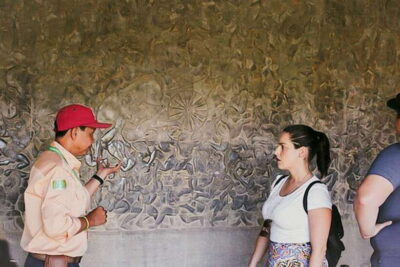
Angkor Wat 2-Day Tour with Sunrise and Sunset
Read our review →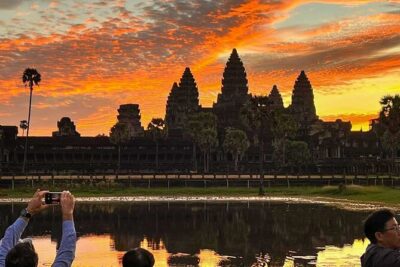
Angkor Wat Sunrise tour with Small – Group and Guide tours
Read our review →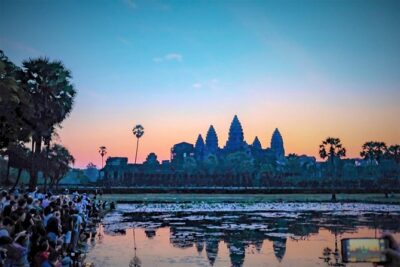
Angkor Wat Highlights and Sunrise Guided Tour from Siem Reap
Read our review →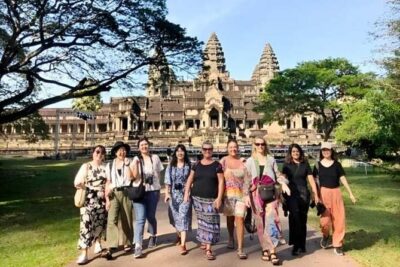
Angkor Wat Sunset Small Group Tour with Lunch Included
Read our review →
Full-Day Angkor Wat Sunrise Private Tour with Guide from Siem Reap
Read our review →Browse the lists this tour appears in