Review · SIEM REAP TOURS
Angkor’s Finest Examples in Brief
Three temples, one memorable Angkor day. This full-day circuit is built for people who want the big UNESCO hits in one go, with a private format and a tight focus on Angkor Wat plus the surrounding masterpieces. You’ll ride out from Krong Siem Reap in an air-conditioned vehicle, guided the whole way.
I especially like the hotel pickup and the way the day moves like a plan, not a scavenger hunt. You’ll get standout moments like the Bayon’s hundreds of smiling faces and the elephant-terrace details at Angkor Thom without losing your morning to logistics.
One thing to watch for: the Angkor Archaeological site entrance pass is not included, so budget extra and expect to purchase it at the ticket counter.
In This Review
- Key Highlights Worth Planning For
- A smart full-day Angkor circuit from your Siem Reap hotel
- Price and what you really get for your money
- Morning logistics: pickup timing, the ticket counter, and the first walking stretch
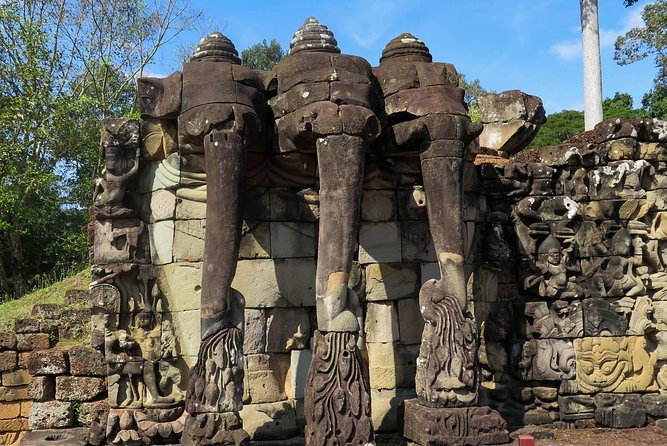
- Angkor Thom: Bayon faces, Elephant Terrace, and the Terrace of the Leper King
- Elephant Terrace: animal power in stone
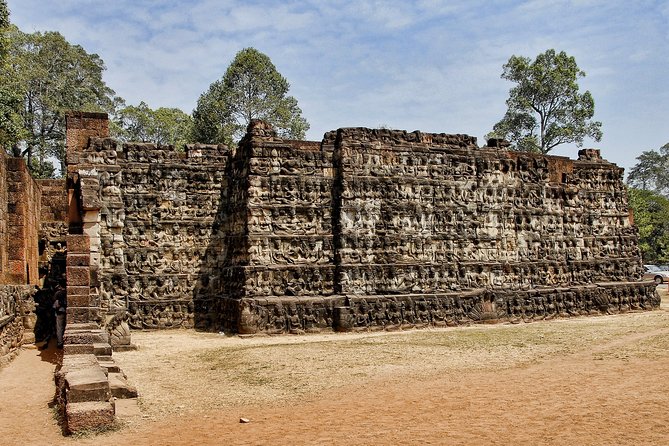
- Terrace of the Leper King: a name with a mystery
- Bayon: hundreds of gentle faces, plus a current reconstruction note
- Ta Prohm: the jungle temple effect and the “left in place” choice
- Angkor Wat: the west-facing powerhouse and your outside sunset window
- Sunset from outside: what to expect
- Guide quality and the private format, especially at the face-heavy sights
- What to wear, bring, and watch for at strict temple entrances
- Timing, pacing, and comfort on a long temple day
- Who this tour is best for
- Should you book this Angkor Wat day tour?
- FAQ
- Is the Angkor Archaeological site entrance pass included?
- What time does the tour start?
- How long is the tour?
- Is hotel pickup and drop-off included everywhere?
- What should I wear to the temples?
- Is this tour private, and will the guide speak English?
- Can I cancel and get a full refund?
Key Highlights Worth Planning For
- Angkor Thom in depth, including the Elephant Terrace, the Terrace of the Leper King, and Bayon’s face towers
- Ta Prohm as a jungle temple, left partly in place to show how it was first found
- Angkor Wat late-afternoon timing, with sunset viewing from outside before you return to your hotel
- A private English-speaking guide, so you can ask questions and pace the stops
- Bayon reconstruction affects views, since only lower levels are visible right now
A smart full-day Angkor circuit from your Siem Reap hotel
If Angkor Wat is the reason you came to Siem Reap, this is the cleanest way to stack the rest of the must-sees on the same day. You start around 8:00am, visit Angkor Thom first, then Ta Prohm, then finish at Angkor Wat in the afternoon.
What I like about this format is that it keeps you focused. You’re not bouncing around aimlessly across the whole region. Instead, you get a clear sequence of the most famous temple styles, from walled capital-city remains to jungle-grown stone to the grand, west-facing Angkor Wat complex.
And since it’s a private tour with an English-speaking guide, you can move at a comfortable pace and still get the “why this matters” context behind the carvings and layouts.
Others in Siem Reap worth putting side by side:
- Angkor Wat Sunrise or Sunset Tour with Guide from Siem Reap
★ 5.0 · 12,109 reviews - Siem Reap: Angkor Wat: Small-Group Sunrise or Sunset Tour
★ 5.0 · 9,444 reviews - From Siem Reap: Kampong Phluk Floating Village Tour by Boat
★ 4.9 · 6,979 reviews
Price and what you really get for your money
The listed price is $141.44 per person for a day that runs about 9 hours 30 minutes. That includes round-trip hotel pickup and drop-off (within the Siem Reap area), transportation in an air-conditioned vehicle, and a professional English-speaking guide.
The big value piece is simple: you’re paying for time management. Angkor days can turn chaotic fast, mostly because you’re mixing temple walking, ticket logistics, and heat. This tour handles the driving and guides you through the key stops, so you can spend your energy looking up at stone faces and carvings instead of coordinating everything yourself.
The main cost addition is also simple: the Angkor Archaeological site entrance pass is not included. In practical terms, you’ll buy the temple pass at the start of the day when you reach the ticket area. If you’re trying to budget tightly, plan on adding the pass cost early rather than hoping it’s bundled.
Morning logistics: pickup timing, the ticket counter, and the first walking stretch
You’ll be picked up from your hotel in Siem Reap around 8:00am and taken to the ticket counter. The day starts by getting your Angkor entry sorted, then you head straight to Angkor Thom, the last capital of the Khmer Empire.
The tour notes that some walking is required, but they aim for the most comfortable routes between temple entrances and features. That matters because Angkor’s biggest “cost” is time spent moving on uneven ground, not just time spent standing in lines.
Also, plan for weather and your electronics. The guide service explicitly warns that natural elements can damage phones and cameras, so if it’s humid or rainy, keep devices protected and out of sudden downpours.
Angkor Thom: Bayon faces, Elephant Terrace, and the Terrace of the Leper King
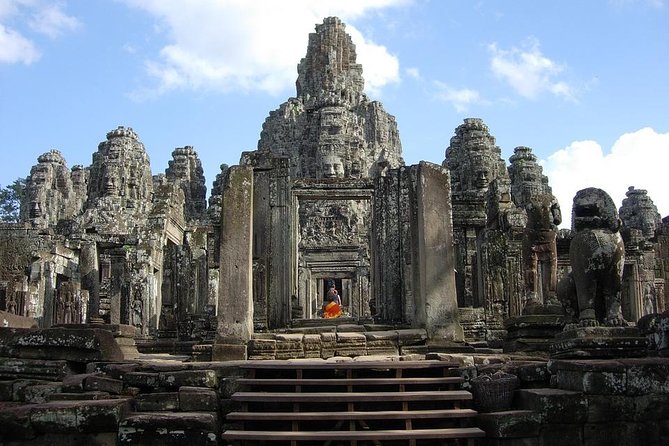
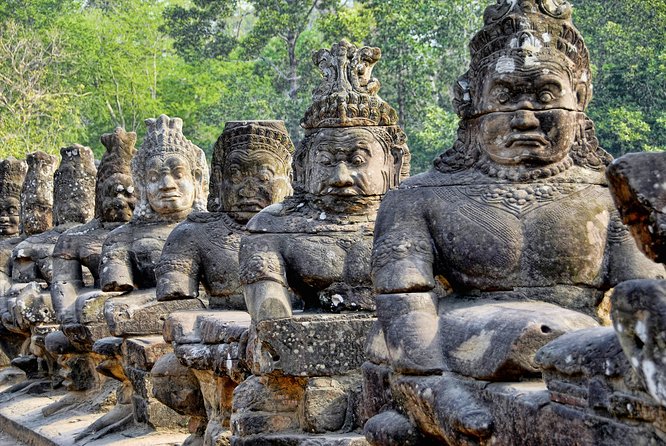
Angkor Thom is where you get your first big sense of scale. This is a walled city area and an archaeological wonder built for symmetry and grand presence, with the Bayon temple sitting near the center.
A different kind of day in Cambodia:
- Sunset tour of Kampong Phluk stilts home village on the Tonle Sap
★ 5.0 · 4,865 reviews - Siem Reap: Angkor Wat 2-Day Tour with Sunrise and Sunset
★ 4.9 · 4,429 reviews - Siem Reap: Kampong Phluk Floating Village Tour with Boat
★ 4.9 · 3,843 reviews - Siem Reap: Full-Day Angkor Wat Guided Tour with Sunset
★ 4.9 · 3,803 reviews
Elephant Terrace: animal power in stone
At the Elephant Terrace, you’ll see the kinds of relief details that make Angkor feel alive. Even without reading every inscription, you can follow the craftsmanship through repetitive forms and the way figures are carved to guide your eye.
This is the kind of stop that slows you down, because once you start noticing the smaller carvings, you want a few extra minutes. A private guide helps here, because you can ask where to look next instead of feeling rushed.
Terrace of the Leper King: a name with a mystery
The Terrace of the Leper King is famous by name, even if the story behind the naming is more complicated than the nickname suggests. What you’ll get in practice is a strong “temple platform” viewpoint and more relief work along the galleries.
It’s also a useful contrast to the Bayon, because platforms and galleries are often about processional movement and visual storytelling. You see the architecture as something meant to be walked through, not just photographed from one angle.
Bayon: hundreds of gentle faces, plus a current reconstruction note
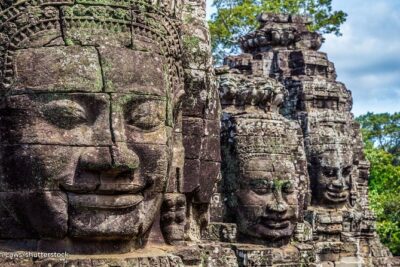
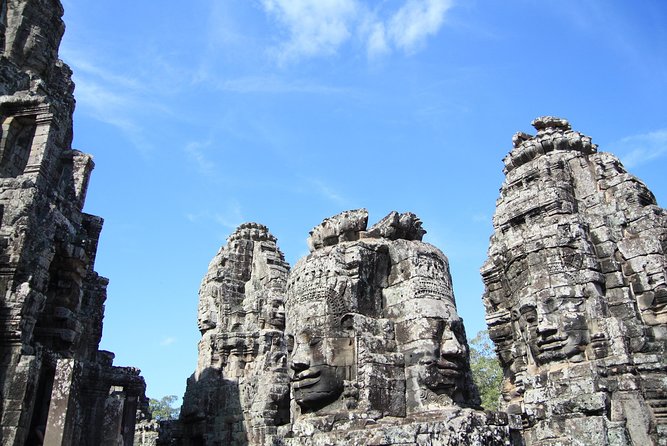
Then you reach Bayon, with its signature towers topped by 3 or 4 gently smiling faces, with 200-plus faces across the complex. The carvings and the sheer repetition make it feel like the temple is watching you back.
There is one important modern detail to know: the top two levels of Bayon are being reconstructed, so visitors may only see the faces at the first and second level. This doesn’t ruin the visit, but it does change what you can see compared with older photos. If you’re picturing the whole-height view from every angle, calibrate your expectations and focus on the main face towers you can still access.
Timewise, Angkor Thom is allotted about 3 hours on this tour, which is enough for a guided walk through the central sights without turning the day into a sprint.
Ta Prohm: the jungle temple effect and the “left in place” choice
After Angkor Thom, you move into Ta Prohm, one of the most recognizable Angkor temples because it looks like the jungle is winning. The tour frames it well as a place that was designed as a shrine by Jayavarman VII in the late 12th century, honoring his mother.
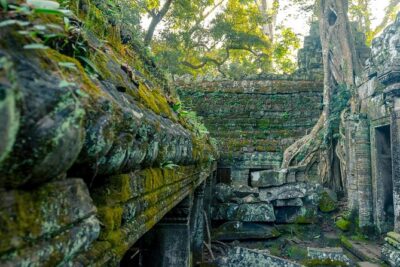
Here’s why the site feels special in person: when the forest was cleared, a decision was made to leave parts in place. The goal was to preserve a reminder of how the original discoverers found these temples, and you can feel that idea walking among the tree roots and stone corridors.
Ta Prohm is allotted about 1 hour 30 minutes. That’s a workable amount of time because this temple can pull you in different directions. You might want to photograph the strangler fig roots, then suddenly want to walk closer to see how they interact with doorways and carvings.
One practical note: this stop is usually where you’ll feel the day’s heat the most, because you’re spending time in shaded patches and open light. If you packed a hat and sunscreen, you’ll be glad. If you didn’t, you’ll notice.
Angkor Wat: the west-facing powerhouse and your outside sunset window
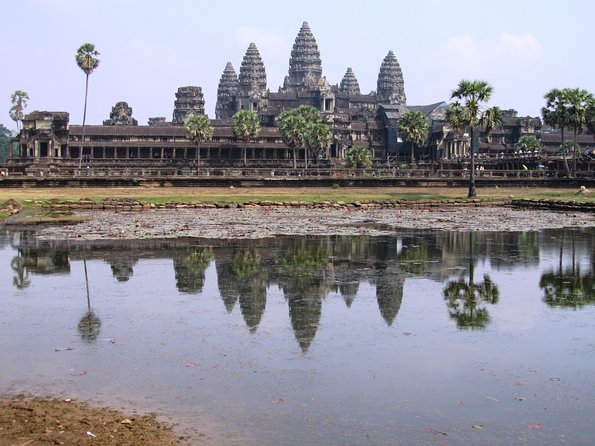
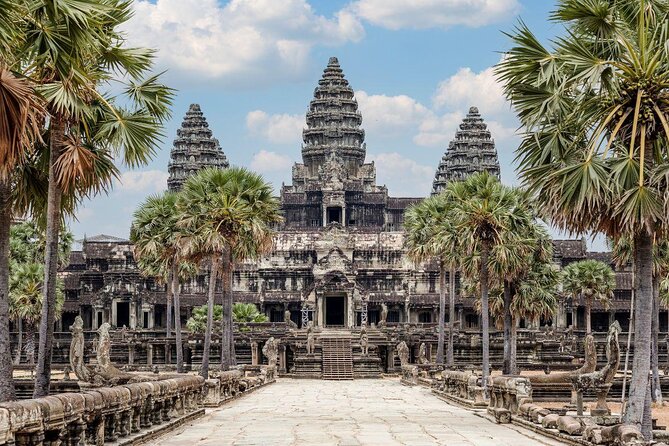
Angkor Wat is the final anchor of the day, set aside for about 2 hours 30 minutes. It’s described as arguably the largest religious building in the world, with a stone volume comparable to the Great Pyramid of Cheops in Egypt, and it’s also distinct because it faces west.
That west-facing orientation matters for how you experience it. The light across the structure shifts through the afternoon, and the symmetry you see in the towers and corridors makes it easier to understand the temple as a designed whole, not a collection of unrelated buildings.
The Cambodian flag symbolism is also part of the tour’s story. The symmetric towers are described as stylized on the modern Cambodian flag, which helps connect what you’re seeing in stone to how people today recognize national heritage.
Sunset from outside: what to expect
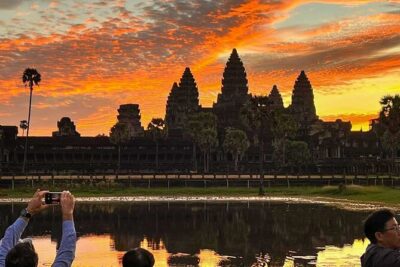
You’ll have time to admire sunset from outside Angkor Wat before returning to your hotel around 5:30pm. This is a practical compromise. You still get the iconic change of light and the mood shift that makes Angkor feel different, but you’re not stuck in a long situation late in the day.
If you’re someone who wants the most perfect photo angles, remember that you may not be in the exact place you imagined from your phone map. It’s still worth it, mostly because sunset is when the stone and shadow contrast makes the details pop.
Guide quality and the private format, especially at the face-heavy sights
This tour leans hard on the guide. You’re getting a professional English-speaking guide for the day, and the feedback highlights how much that changes your experience. In the notes from previous bookings, Pitt comes up as a standout, praised for having very strong English and for being attentive and informative. Another guide name you may see in the same feedback is Mr. Pising, recognized for being attentive as well.
Even if you don’t get the same guide, the setup is designed to let you get more out of the carvings and architecture. In Angkor, it’s easy to walk up, snap photos, and move on. With a good guide, you start noticing patterns, and you learn what to look for first so the site stops feeling like visual noise.
The private format matters too. Several comments emphasize being able to avoid crowd-pressure and still have room to explore on your own for a bit. That balance is ideal for me: guided context first, then a little freedom to wander without feeling lost.
What to wear, bring, and watch for at strict temple entrances
Angkor is not just about seeing temples, it’s also about getting admitted to them.
The dress code is strict at some sights, including places like Baphuon. Plan to wear clothes that cover shoulders and fall below the knees. Shirts with obscene or disrespectful prints and pictures, and brightly colored clothing, may lead to refusal of entry. This is one of those rules that can spoil your day fast, so pack accordingly.
On the “bring” side, the tour strongly suggests sunglasses, a hat or cap, and high SPF sunblock, even if it’s cloudy. In Cambodia, “cloudy” doesn’t mean “safe from strong sun.” You’ll also want water and a plan for breaks, since the day includes multiple walking segments.
There’s also a note about passport pages for arrival visa issues. It advises that your passport should have at least two empty pages to avoid problems at the airport.
Timing, pacing, and comfort on a long temple day
This day runs close to 10 hours on paper, and close to a full workday in reality. You’ll be moving through three main temple zones with different vibes, and that variety helps. Angkor Thom feels monumental and civic, Ta Prohm feels natural and dramatic, and Angkor Wat feels ceremonial and formal.
A helpful detail in the tour info is that they aim for comfortable ways between the entrances and the sights themselves. That doesn’t eliminate walking, but it can reduce the worst detours.
Also, be realistic about your energy for cameras and phones. The tour warns that weather can damage electronics, so keep your gear protected, especially if you’re carrying it out to open areas.
Who this tour is best for
This is a strong pick if you:
- want the main Angkor hits in one day without trying to stitch together three separate tours
- like having a guide explain what you’re seeing, especially with Bayon and Ta Prohm’s story
- prefer a private setup so your timing is less tied to random group pacing
- are short on time in Siem Reap, since you can cover Angkor Thom, Ta Prohm, and Angkor Wat before dinner plans
It may be less ideal if you:
- want a fully self-guided day where you control everything, including ticketing and navigation
- hate strict dress rules, because you’ll want to follow the temple clothing guidelines carefully
- don’t want to pay extra for the Angkor site pass, since it’s not included
Should you book this Angkor Wat day tour?
I’d book this if your priority is seeing the core Angkor sites with a guide who keeps the day organized, and if you’re fine paying separately for the entrance pass. The value is in the structure, the private pacing, and having a guide to help you read the sites while you’re there.
I’d think twice if you’re trying to minimize any extra costs, because the Angkor Archaeological site pass is mandatory and not included in the base price. Also, if you’re picturing a perfect, full-height view of Bayon, remember that reconstruction is currently limiting what you can see on the upper levels.
If you dress correctly, bring sun protection, and accept that this is a long temple day, you’ll likely come away feeling like you covered the essentials without wasting time.
FAQ
Is the Angkor Archaeological site entrance pass included?
No. The tour includes the guided experience and transportation, but the Angkor Archaeological site entrance pass is not included. You’ll buy the temple pass at the ticket counter at the start of the day.
What time does the tour start?
Pickup starts around 8:00am.
How long is the tour?
It runs for approximately 9 hours 30 minutes.
Is hotel pickup and drop-off included everywhere?
Pickup and drop-off are included only for accommodations in and inside Siem Reap. Transfers outside those areas, including places like Tonle Sap, Koh Ker, Banteay Srei, and Siem Reap International Airport, are excluded.
What should I wear to the temples?
Some Angkor sights have a strict dress code. You need clothes that cover shoulders and fall below the knees. Brightly colored clothing and shirts with obscene or disrespectful prints may be refused entry.
Is this tour private, and will the guide speak English?
Yes. It’s a private tour with an English-speaking professional guide. Other languages are available on request, subject to availability and possible supplementary charges.
Can I cancel and get a full refund?
Yes. You can cancel for a full refund up to 24 hours before the experience’s start time.
Newly listed around Siem Reap
- Sambor Prei Kuk Off Beaten Track★ 5.0 · 3 reviews
- Siem Reap Airport Taxi Transfer – City Center Hotels★ 5.0 · 5 reviews
- Short Cycling at Countryside★ 5.0 · 29 reviews
- Unveiling the Mystical Beauty of Phnom Kulen National Park★ 5.0 · 6 reviews
- Angkor Wat at Sunrise★ 4.0 · 7 reviews
- Bakong Temples & Floating Village Tour★ 4.5 · 3 reviews
- Rooftop Romantic Dinner – 4 Courses Set Meal & Wine★ 3.5 · 5 reviews
- Khmer Cooking Class in Cambodia★ 5.0 · 36 reviews
Siem Reap Tours, compared.
Angkor Wat Sunrise or Sunset Tour with Guide from Siem Reap
Read our review →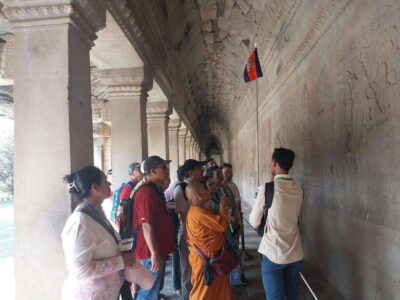
Angkor Wat: Small-Group Sunrise or Sunset Tour
Read our review →
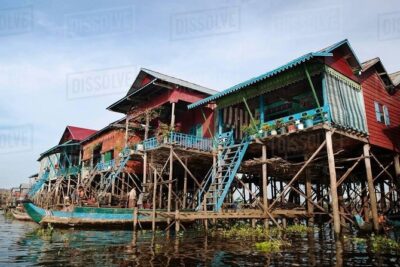
Sunset tour of Kampong Phluk stilts home village on the Tonle Sap
Read our review →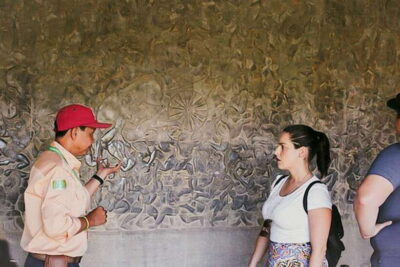
Angkor Wat 2-Day Tour with Sunrise and Sunset
Read our review →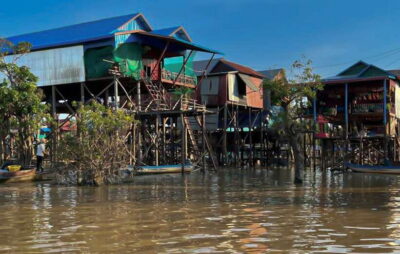
Kampong Phluk Floating Village Tour with Boat
Read our review →