Review · ANGKOR WAT TOURS
Private Full-Day Sunrise Tour in Angkor Wat Temple
Sunrise at Angkor is a cheat code for atmosphere. This private full-day route strings together Angkor Wat, the big sights of Angkor Thom, and the tree-root drama of Ta Prohm, with an English guide and early pickup.
I especially like two things. First, you get the rare early-light moment at Angkor Wat, then you stay long enough for the inside galleries instead of rushing off. Second, the guide support is built for real learning, with clear explanations of Khmer temple meaning and plenty of chances to ask questions (and get help with photos).
The main drawback to weigh is the early start, plus the fact that the Temples Pass is extra. If you’re not a morning person, you’ll feel it, even though the schedule is designed to get the best light and cooler temps.
In This Review
- Key highlights you should know before you go
- Why a 4:30 am start makes sense for Angkor Wat
- Angkor Wat sunrise and the gallery walk that makes the stone feel alive
- Angkor Thom South Gate: Naga giants and the Devas versus Asuras tug-of-war
- Bayon Temple faces: three tiers, 49 towers, and carvings that cover real life
- Baphuon’s carved surfaces and Mount Meru symbolism
- Phimeanakas and the royal-enclosure cooling effect
- Terrace of the Elephants: long views and a royal-building scale
- Ta Nei: a smaller late 12th-century Buddha dedication
- Ta Prohm: the tree-root temple and the real reason it looks like a movie set
- Lunch around noon, heat management, and how the pacing feels in real life
- Price and temples pass: is $43 really good value?
- Guide support that turns a temple day into a story you can follow
- Who this sunrise Angkor tour is best for
- Should you book this private Angkor Wat sunrise tour?
- FAQ
- What time does the tour start?
- How long is the private sunrise tour?
- What’s included in the $43 price?
- What are you required to pay separately?
- Is this tour private?
- What if weather is bad?
Key highlights you should know before you go
- 4:30 am start that sets you up for sunrise at Angkor Wat when the light is at its best
- South Gate of Angkor Thom with the moat causeway, Naga balustrades, and the Devas versus Asuras tug-of-war
- Bayon’s face towers plus bas-reliefs that show battle scenes, apsaras, naval moments, and everyday life
- Baphuon and Phimeanakas give you a break from crowds while still staying deep in major royal-enclosure history
- Ta Prohm’s tree roots where the popular movie look is tied to the temple’s real age and design
- English guide with photo help and extra storytelling time so you do not just look, you understand
Why a 4:30 am start makes sense for Angkor Wat
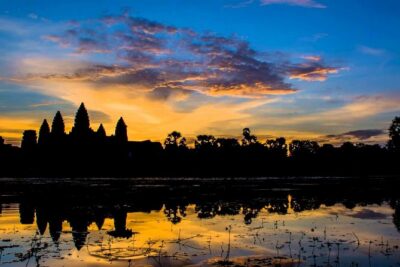
This tour kicks off at 4:30 am, which sounds aggressive until you see why it works. Angkor Wat is at its most magical in the early hours, when the light hits the stone just right and the whole place feels calmer before the day crowds arrive.
The other reason the morning start pays off is comfort. You’re moving temples in big open-air areas, so cooler temperatures help. You also get to build momentum early, then you can shift into a more normal pace later in the day.
If you dislike wasting time, the pickup-and-drop setup helps. You can be collected (and dropped at the airport) and travel in an air-conditioned vehicle. That matters because you spend a lot of the day outdoors, and you want the in-between time to be easy.
More Angkor Wat tours in Siem Reap:
- Angkor Wat Sunrise or Sunset Tour with Guide from Siem Reap
★ 5.0 · 12,109 reviews - Siem Reap: Angkor Wat: Small-Group Sunrise or Sunset Tour
★ 5.0 · 9,444 reviews - Siem Reap: Angkor Wat 2-Day Tour with Sunrise and Sunset
★ 4.9 · 4,429 reviews
Angkor Wat sunrise and the gallery walk that makes the stone feel alive
Angkor Wat is the star here, and the tour treats it like the star. You start with sunrise over Angkor Wat, then you move into the temple galleries inside for about 3 hours total at this stop.
The sunrise is not only about pretty views. It is also the best time to spot the temple’s geometry. From this perspective, the causeways, courtyards, and layers start to “click” as part of a designed story. Later, when you walk through the galleries, the guide’s explanations help you connect the carvings to the bigger picture.
What you get in the galleries is more than walking from one wall to the next. You’ll get the stories and meaning the guide ties to the site, so the bas-reliefs are not just decoration. They become scenes you can recognize, like recurring Khmer themes, figures, and symbolic design choices.
One practical note: you should plan for standing and walking in the temple complex. Comfortable shoes are non-negotiable. If you arrive even slightly stiff, the long early walk will remind you why early mornings always feel faster than expected.
Angkor Thom South Gate: Naga giants and the Devas versus Asuras tug-of-war
After sunrise, you shift to Angkor Thom, and the first dramatic moment is the South Gate. This is where your eyes get hit with scale fast: you approach the causeway that crosses a 100 m wide moat.
The Naga balustrade is the visual “work of art” that also acts like a guide. You are looking along serpent imagery, and you learn the detail of what is carved and who is pulling whom. The big seven-headed Naga motif is held by a multi-armed and multi-headed giant, and on either side you see 54 stone giants tugging.
The Devas versus Asuras contrast is what makes the story stick. One side shows Devas with slender eyes and a casual smile, while the other side shows Asuras with round bulging eyes and grimacing faces. It reads like a never-ending struggle, good and evil pulling the same reality in opposite directions.
Time-wise, this stop is brief, about 15 minutes. That’s good news if you want your morning to keep moving. The tradeoff is you cannot linger at every carved surface. If you love photo time, consider focusing on the causeway action first, then come back only if there is an easy spot.
Bayon Temple faces: three tiers, 49 towers, and carvings that cover real life
Next comes Bayon Temple, the highlight inside Angkor Thom’s core. Bayon was built by King Jayavarman VII in the late 12th or early 13th century. It is also notable as the only state temple in the Angkor complex dedicated to a Mahayana Buddha.
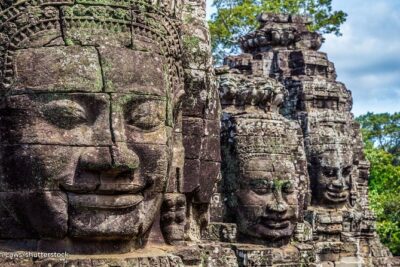
The most famous feature is the cluster of faces. Bayon has 49 towers, and the towers were decorated with the four big smiling faces of Buddhist at the later Avalokesvara style. When you look up through the courtyards, it feels like the temple is looking back at you.
The experience becomes stronger when you take the tiers slowly. You explore the three levels, then look up and down to catch the faces from different angles. That is where the temple’s design becomes more than iconic.
Bayon also gives you storytelling through bas-reliefs. The carvings cover Khmer armies, apsaras, naval battles, fishermen, cockfights, and more everyday scenes. This is one of those places where a guide makes the difference, because you start recognizing patterns across scenes instead of seeing random figures.
The main consideration at Bayon is crowds and noise. This stop tends to be busy, so you might find it harder to slow down exactly where you want. I suggest you pick two or three “must shoot” angles, then use the rest of the time for the carvings and the face tiers.
A few more Siem Reap trips to compare
- Full-Day Angkor Wat Sunrise Private Tour with Guide from Siem Reap
★ 5.0 · 2,920 reviews - Siem Reap: Angkor Wat Private Tuk-Tuk Tour
★ 4.9 · 2,222 reviews - Angkor Wat Private Day Tour from Siem Reap
★ 5.0 · 834 reviews - Angkor Wat Private Tuk-Tuk Tour (sunrise Option) & more
★ 5.0 · 439 reviews
Baphuon’s carved surfaces and Mount Meru symbolism
After Bayon, you go to Baphuon Temple, a major stop with a different mood. It is described as the prototype for the Baphuon style, covering nearly every available surface with intricate carvings.
This is where your eyes need a little time to adjust. The carvings include realistic and fanciful animals, lotus flowers, hunters, devata figures, and scenes of men in battle. It also includes indirect references to Hindu mythology, plus epic poem scenes connected with the Ramayana.
What ties it together is the symbolism. The sandstone temple-mountain represents the sacred five-peaked Mount Meru, important in both Hindu and Buddhist cosmology. The guide’s explanations help you see why the architecture is not random. It follows the idea of a sacred mountain in stone.
You spend about 40 minutes here. That is enough to get a sense of the overall design, plus enough time to pick a few areas of carving for closer looks. If you try to see every square inch, it will overwhelm you. So I recommend a simple strategy: first, understand the layout, then choose a carving zone to study for a few minutes.
Phimeanakas and the royal-enclosure cooling effect
Phimeanakas is part of the royal enclosure, so you feel that shift from pure temple spectacle to a more court-like zone. The tour description emphasizes that it is a temple with a story, and it is likely you pass through the area as you move around.
The best practical detail is the setting. The area surrounding Phimeanakas has thick trees and ponds, which can feel cooler during the hot afternoon. That makes it a smart mid-day stop even if you are tired. It also gives your eyes a break from constant sun glare on stone surfaces.
Time here is about 30 minutes. In that window, you get to notice how the temple sits within a lived-in environment, with water and shade shaping the mood. If you are the type who likes to understand how people might have moved through the space, this is one of the calmer moments of the loop.
Terrace of the Elephants: long views and a royal-building scale
Next is the Terrace of the Elephants, built by King Jayavarman VII at the end of the 12th century. The terrace runs over more than 300 meters, stretching from Baphuon in the south to the Leper King terrace to the north.
This is one of the places where you understand “scale” in a physical way. You are not just standing before a single structure, you are looking at a long royal platform shaping movement through the grounds. It helps you picture ceremonial processions and court life, not just temple worship.
The stop is about 30 minutes, which again pushes you toward a balanced approach. Take in the length, look for key carving or architectural transitions, and then move on rather than getting stuck in one corner.
Ta Nei: a smaller late 12th-century Buddha dedication
Ta Nei is shorter and more low-key compared with the big face-and-root stops. It is a late 12th-century stone temple built during Jayavarman VII’s reign, near the northwest corner of the East Baray, a large holy reservoir. It was dedicated to the Buddha.
This stop is about 15 minutes, so think of it as a palate cleanser. If you need a moment to reset after more visually packed sites, Ta Nei does that well. You also get a connection point between Angkor’s religious layers and its water-based sacred design.
Because time is limited, you should not expect a slow wander everywhere. Still, it’s a nice chance to see a different type of temple feel without burning half the morning on it.
Ta Prohm: the tree-root temple and the real reason it looks like a movie set
Finally, you head to Ta Prohm, originally called Rajavihara, meaning Monastery of the King. It was built in 1186 AD by King Jayavarman VII.
This is the temple famous for the gigantic tree roots. It is also identified as the location tied to the Tomb Raider movie look, which helps modern visitors connect instantly. But the value here is deeper than the film association. The roots are part of the temple’s current visual identity, and the way the stones and trees meet tells you a lot about how nature and architecture interact over centuries.
You spend about 1 hour at Ta Prohm. That is the right amount of time for the “slow look” that these roots deserve. Walk around enough to see how the roots frame doorways and towers, then pause where the composition looks best.
If you care about photos, this is typically a high-hit site. Just remember that some angles can get congested. I suggest shooting your must-have views quickly, then using the rest of your time to notice stone details between the roots.
Lunch around noon, heat management, and how the pacing feels in real life
The morning temple circuit runs hard, but it is paced so you can breathe again. After the busy early hours, you reach lunch around 12:00 pm, with food at a local restaurant nearby Angkor Wat.
This timing is smart. By mid-day, the heat can press down, and lunch acts like a reset button after multiple hours of stone-on-stone walking. You also get a natural break before you head into the final main stop areas like Ta Prohm.
What you should take seriously is hydration. The tour includes bottled water, which helps. Still, if you sweat easily, plan to drink early and often, not only when you feel thirsty. Morning sunrise tours can trick you into underestimating how much water you need until you’re fully in the hot part of the day.
Price and temples pass: is $43 really good value?
The tour price is $43.00 per person, and it includes pickup, an air-conditioned vehicle, bottled water, an English tour guide, plus parking fees and road tolls. That matters more than it sounds. In Siem Reap, transportation and timed access add up fast, and paying extra just to get a car and a guide can be a hidden cost on less-organized tours.
But you do need to budget for the Temples Pass. The pass is listed as 1 Day = $37 per person, and it covers the places you visit. Temples pass is not included in the $43 price, so your realistic day cost is closer to $80 total per person if you purchase that pass.
Is that still a good deal? For a full-day private tour covering Angkor Wat, Angkor Thom highlights, and Ta Prohm, with an English guide and included transport, yes. You are paying for a lot of structured time with reduced stress. If you were to DIY the same sequence, you would spend money anyway on a pass, tuk-tuk or car rides, and time planning.
The one tradeoff is the schedule density. You get many major temples in one day, so if you want a slow, meditative pace with fewer stops, you might feel a little “temple fatigue.” Still, the guide can help keep things intelligible as you move, which makes the day feel shorter.
Guide support that turns a temple day into a story you can follow
One of the most praised parts of this experience is the guide experience. Multiple guides are highlighted for strong English, big energy, and a habit of answering questions clearly.
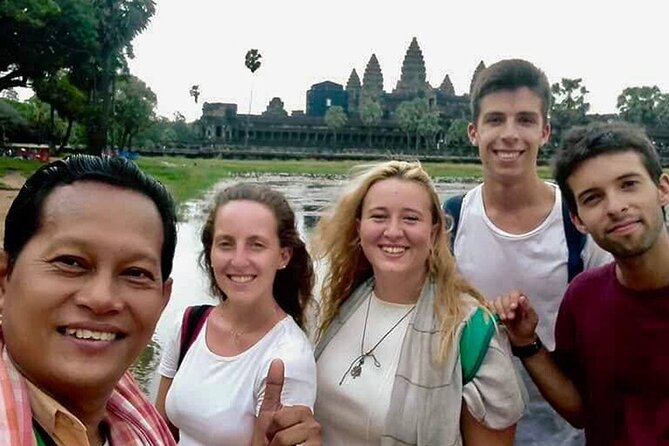
You may encounter a guide like Chanra, who is described as friendly, passionate, and devoted to Cambodian culture, with a knack for helping with photos. Another name that comes up is Manoune, praised for hospitality and adjusting time to match a group’s pace. A third guide name you might see mentioned is Bob, noted for giving lots of information during a loop tour and keeping conversations going during transit.
What I take from that pattern is simple: this is not meant to be a silent bus ride. You are guided through meaning, not only through locations. That is the difference between taking pictures and actually understanding why the faces on Bayon matter, why the Naga tug-of-war symbolism is placed where it is, and why Baphuon’s Mount Meru references shape the view.
There are also small comfort touches mentioned in guide feedback, like refreshing towels after stops, plus picture help. Those details do not change the monuments, but they change your comfort level, which changes how much you enjoy the day.
Who this sunrise Angkor tour is best for
This works best if you want a big “greatest hits” day and you like structure.
Good fit:
- Couples, families, or small groups who want a private experience and hate feeling herded
- First-time Angkor visitors who want the meaning behind the scenes, not only photos
- People who can handle a very early start for sunrise
You might not love it if:
- You need a slow pace and long breaks between stops
- You get grumpy with crowds, since Bayon is described as very busy
- You want every stop to be optional, since the route is tightly planned for a full-day window
The good news is that the tour is designed to keep your day logical, with a lunch break around noon and a mix of major wow sites and slightly calmer royal-enclosure moments.
Should you book this private Angkor Wat sunrise tour?
If you are choosing between “see Angkor sometime” and “see Angkor in the right order,” I think this one is a solid call. The sunrise at Angkor Wat plus a guided walkthrough of the galleries is a smart combo. Then the route gives you the major Angkor Thom landmarks, and it finishes with Ta Prohm, where the tree roots deliver the wow factor.
Book it if you want value from one day: organized transport, English guidance, bottled water, and a route that covers the big highlights without making you plan every turn.
Skip it or consider a different option if you cannot handle 4:30 am starts or you prefer fewer temples with more time at each one. The day is packed, and your enjoyment will depend on whether you like momentum.
If you do book, do yourself one favor: buy your Temples Pass budget early, wear real walking shoes, and treat sunrise as your reward for getting up before the alarm.
FAQ
What time does the tour start?
The tour starts at 4:30 am.
How long is the private sunrise tour?
The duration is listed as about 7 hours.
What’s included in the $43 price?
The tour includes bottled water, an air-conditioned vehicle, English tour guide, and parking fees and road tolls. Pickup/drop-off at the airport is also included.
What are you required to pay separately?
You’ll need a Temples Pass. The pass is listed as 1 Day = $37 per person.
Is this tour private?
Yes. It is a private tour/activity, and only your group will participate.
What if weather is bad?
This experience requires good weather. If it is canceled due to poor weather, you will be offered a different date or a full refund.
Newly listed around Siem Reap
- Sambor Prei Kuk Off Beaten Track★ 5.0 · 3 reviews
- Siem Reap Airport Taxi Transfer – City Center Hotels★ 5.0 · 5 reviews
- Short Cycling at Countryside★ 5.0 · 29 reviews
- Unveiling the Mystical Beauty of Phnom Kulen National Park★ 5.0 · 6 reviews
- Angkor Wat at Sunrise★ 4.0 · 7 reviews
- Bakong Temples & Floating Village Tour★ 4.5 · 3 reviews
- Rooftop Romantic Dinner – 4 Courses Set Meal & Wine★ 3.5 · 5 reviews
- Khmer Cooking Class in Cambodia★ 5.0 · 36 reviews
Angkor Wat Tours, compared.
Angkor Wat Sunrise or Sunset Tour with Guide from Siem Reap
Read our review →
Angkor Wat: Small-Group Sunrise or Sunset Tour
Read our review →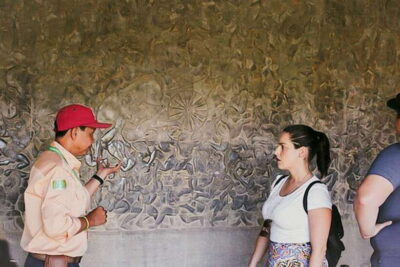
Angkor Wat 2-Day Tour with Sunrise and Sunset
Read our review →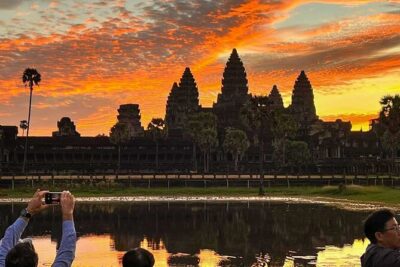
Angkor Wat Sunrise tour with Small – Group and Guide tours
Read our review →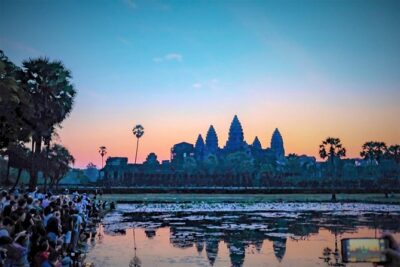
Angkor Wat Highlights and Sunrise Guided Tour from Siem Reap
Read our review →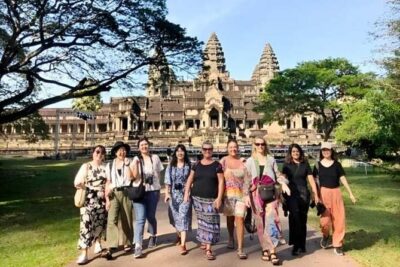
Angkor Wat Sunset Small Group Tour with Lunch Included
Read our review →