
Review · COUNTRYSIDE & VILLAGE TOURS
Kampot: Cultural Bike Experience – Local Life & Countryside
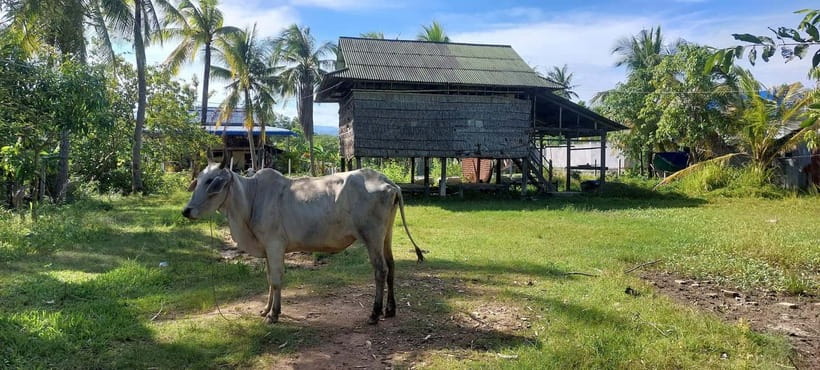
Rural Kampot has a bike-shaped secret. This easy, flat countryside route takes you past village pagodas, working farms, and family-run traditions, with stops that turn a simple ride into real context for how Cambodia lives day to day. I especially like two parts: the Buddhist temple walks where you learn what you’re seeing, and the homecooked Cambodian lunch with a local family. The only real drawback is it’s not a sit-and-watch tour, so if you can’t ride a bike confidently or you dislike walking on temple grounds, you’ll feel it.
Starting from the Kampot Pepper Shop near the Old Market, you slowly pedal out of the tourist bubble. Along the way, your guide, Jason, explains history and culture in a way that feels practical, not like a lecture. Vin also shows up in the experience, and that matters, because the tour’s best moments come from people, not props.
If you want Kampot that feels lived-in, this is a strong pick. It’s also a good way to see a countryside you might otherwise skip because getting around can be tricky without a plan.
In This Review
- Key highlights to know before you go
- Where the tour starts, and how the ride feels
- First countryside push: getting out past the tourist zone
- Wat Jum Kriel: what a village pagoda teaches you
- Tuek Chhou photo stop: the countryside in one pause
- Wat Ang Prey Serey Meanchey: guided temple time plus breathing room
- Lunch at Wat Ang Prey Serey Meanchey: the family-meal payoff
- Wat Prey Tom: finishing with more temple meaning
- Wat Prey Tom to Kampot Pepper Shop: riding back with new context
- Palm sugar and rice farming: what you learn beyond the scenery
- What makes Jason’s guide style work
- Price and value for $35 per person
- Who should book this bike tour, and who might skip
- Should you book it?
- FAQ
- Where is the meeting point for the tour?
- How long is the experience?
- What is the price per person?
- What activities are included during the day?
- Do I get a bicycle rental?
- Is lunch included?
- What language is the tour guide?
- Is the route hilly or flat?
- Who might not be suitable for this tour?
- What is the cancellation and booking flexibility?
Key highlights to know before you go
- Flat countryside cycling with about 15 km covered at a slow, comfortable pace
- Temple visits at three pagodas, with guided explanations of Buddhist practice
- Homecooked Cambodian meal at a traditional wooden house with a local family
- Palm sugar farm stop, run by local families who keep the process hands-on
- Rice farming community visit, with time to understand how rice cultivation works
- English live guide experience, with Jason known for wide-ranging cultural context
Where the tour starts, and how the ride feels
You meet at the Kampot Pepper Shop, near the Old Market. It’s a handy landmark, and it keeps things simple if you are already spending time around the center.
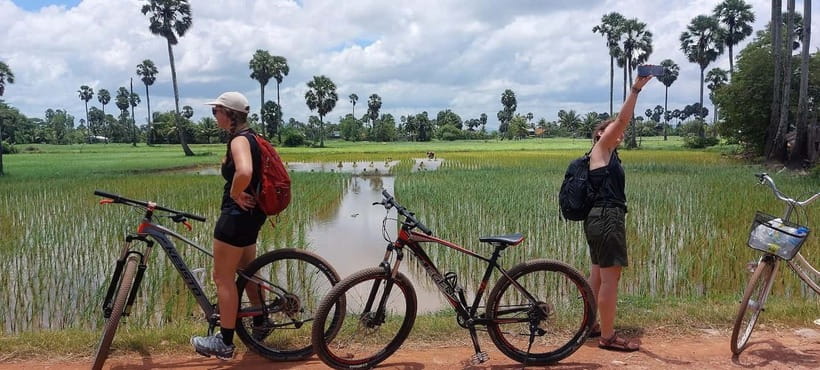
The ride itself is designed to feel relaxed. You cycle around 15 km total, and the route is entirely flat, with no hills. Traffic is described as minimal too, which is great news if you don’t ride a lot. The pace is slow, and there are planned stops to enjoy scenery for about 30 to 45 minutes at a time before moving on to walking breaks.
This matters more than it sounds. When a countryside ride is flat and calm, you can actually look around. You stop noticing the bike and start noticing the rhythm of village life: small paths, fields, animals, and the way people move through their day.
More Countryside & Village Tours in Kampot & Kep
- Kampot: Full-day Countryside Tour with Pepper Farm and Kep
★ 4.9 · 245 reviews - Kampot Countryside include Pepper farm, Salt field & Lake
★ 4.9 · 100 reviews - Kampot’s Countryside & Kayak Tour, Pepper Farm include Lunch
★ 4.8 · 74 reviews
First countryside push: getting out past the tourist zone
Early on, you get a short bike segment and then some scenic time. You’re not just leaving Kampot for the sake of leaving. The goal is to get you off the usual routes and into rural neighborhoods where daily routines are still the main event.
You’ll spend your time between local villages, and the tour uses a mix of cycling and walking so you don’t end up sweating through every stop. The walking parts are where you slow down for context, and that’s where the guide’s job becomes clear. Jason’s explanations are a big part of why this experience feels more meaningful than a scenic loop.
A practical note: wear sunscreen and bring a hat. Cambodia’s sun doesn’t care about cultural enlightenment. Even if you’re moving slowly, you can still cook if you’re not prepared.
Wat Jum Kriel: what a village pagoda teaches you
One of the first temple stops is Wat Jum Kriel (វត្តជុំគ្រៀល). You start with break time, then you do a guided visit and a guided walk around the pagoda area, plus sightseeing.
What makes a stop like this valuable is the translation of what you’re seeing. A pagoda is not just an old building. It’s a living place of practice, and the tour frames it that way. You learn how Buddhism is practiced locally, and you get history and culture tied to the space, rather than vague facts floating around the edges.
The walking time also helps you understand the layout. If you’ve never visited a Cambodian monastery before, you can miss half of it just by speed-walking. Here you slow down on purpose.
Potential drawback: if you’re sensitive to religious sites where you might have to watch your behavior, you’ll want to arrive with a respectful mindset. That’s not a complaint, it’s just the kind of tour where your attitude matters.
Tuek Chhou photo stop: the countryside in one pause
After the first temple segment, there’s a Tuek Chhou stop with a photo stop, sightseeing, and biking time. You’ll get time to pause and look, and you’ll have a chance to capture rural scenes without rushing.
I like these mid-ride pauses because they break up the day. You get a mental reset. And they also help you connect the dots between places. After a temple stop, seeing fields and village paths again makes the whole trip feel like one story, not separate events.
If you’re the type who collects photos but hates staged tourist angles, this is where you usually feel more like you’re recording real life than trying to force a shot.
More Countryside & Village Tours in Kampot:
- Kampot Countryside: Authentic Khmer Cooking Class
★ 4.8 · 21 reviews - FULL DAY – Countryside Tuk-Tuk Pepper Tour + Kep
★ 4.6 · 11 reviews - Kep town: Local tuk tuk to Countryside & Pepper farm
★ 4.6 · 8 reviews - From Siem Reap: Kampong Phluk Floating Village Tour by Boat
★ 4.9 · 6,979 reviews
Wat Ang Prey Serey Meanchey: guided temple time plus breathing room
Next up is Wat Ang Prey Serey Meanchey. You’ll have break time, a photo stop, guided touring, and then free time. There’s also a full hour of lunch later connected to this part of the day.
This combination, guided then unstructured, is smart. The guided portion gives you the “why.” Then the free time lets you look on your own without feeling rushed. You can watch how people move, observe the environment, and ask questions if your guide is nearby.
The tour focuses on Buddhism as a practice, not just architecture. That’s what makes temple time hit harder. You’re not just ticking off a landmark. You’re learning what’s happening there and why it matters to local daily life.
Practical tip: bring a light layer if you get cold in shaded temple areas. It’s common to feel heat outside and then a cooler draft when you step into buildings or shaded courtyards.
Lunch at Wat Ang Prey Serey Meanchey: the family-meal payoff
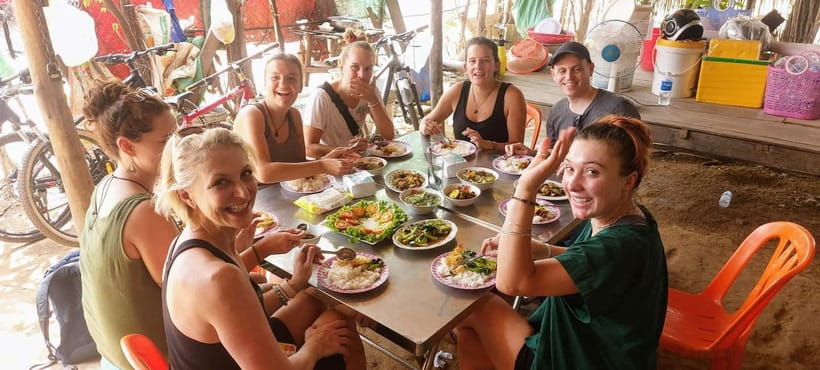
Lunch is listed as part of the Wat Ang Prey Serey Meanchey block, and the experience highlights a homecooked Cambodian meal with a local family at their traditional wooden house.
This is the moment the whole day is building toward. A guided countryside tour is nice, but food with a family is where it gets personal. The tour’s structure signals that you’re not just being served, you’re being included in a normal part of life.
Another reason this lunch matters for value: it saves you from having to hunt for a random meal near the end of the day. You’re also less likely to end up in a place that caters mainly to visitors. Even if you’re not a foodie, you’ll leave with better context for ingredients and everyday cooking.
I’d recommend asking simple questions at the table if your guide encourages it. Where ingredients come from, how dishes are made, what days are best for certain farm work. You’ll usually get answers that fit the day you just rode through.
Wat Prey Tom: finishing with more temple meaning
Later, you’ll visit Wat Prey Tom, with a break time and a guided tour that includes sightseeing. The structure is similar: some slower time to take in the surroundings, then guided explanations that keep you connected to what you’re looking at.
I like that the tour uses three different Buddhist monastaries. It prevents temple visits from feeling repetitive. Even if the style is familiar, each stop gives you another angle on practice, community life, and local interpretation of faith.
If you’ve ever worried that temple tours become “same speech, new sign,” this route works against that problem by pairing each site with countryside cycling and farming stops. Your brain stays engaged because the scenery changes, and the guide keeps linking culture to daily living.
Wat Prey Tom to Kampot Pepper Shop: riding back with new context
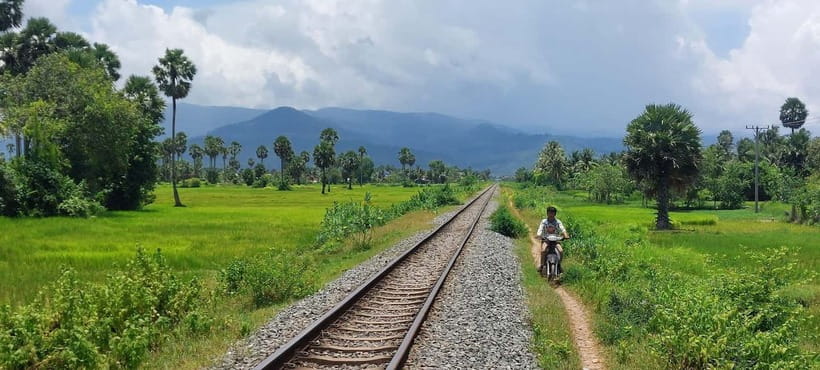
After the final temple visit, you cycle back toward Kampot. There’s a bike segment and scenic drive or scenic views on the way, including time to enjoy the road again.
On the return, I find you start noticing details you ignored earlier. You look at fields with a different set of questions. You see palm sugar connections in places where you used to just see trees. You spot rice patterns and think about the work behind them.
This is a small thing, but it’s why a good guided tour changes how you travel even when you’re just pedaling down a quiet road.
Palm sugar and rice farming: what you learn beyond the scenery
Two of the strongest themes in the experience are farming and local production. You’ll have a stop at a local family run palm sugar farm, and you’ll visit a rice farming community to learn about rice cultivation.
These stops turn “Cambodia has farms” into something you can actually picture. Palm sugar is not just a product. It’s a process that depends on timing and care. Rice cultivation is the foundation of so much of rural life, and understanding how it’s grown helps you make sense of the countryside you’re seeing all day.
The tour also includes explanations about Cambodian culture and history, plus chances to meet local people. You may hear local legends and see village life in ways that you usually miss when you stay strictly in city sights.
Even if you’re not the type who asks about agriculture, you’ll still feel the difference. You stop thinking of farms as background scenery and start seeing them as livelihoods.
What makes Jason’s guide style work
The experience is built around a live English guide, Jason, and that matters for how smoothly the day flows. His breadth and depth of knowledge come through in the way he connects places.
In practice, it means you’re not just walking around and reading a sign. You understand why a pagoda matters, what the community traditions are about, and how village life links back to Cambodia’s broader culture.
One more detail from the experience notes: Vin is mentioned as part of the team. When a tour includes both an English-speaking guide and someone who helps translate or connect you to local people, you tend to get less awkward silence and more real conversation.
Price and value for $35 per person
At $35 per person for about 6.5 hours, this is a reasonable rate, especially because it bundles in real costs that many tours make you pay separately.
You get:
- Bicycle rental
- All drinks
- Lunch
That’s not just convenience. It’s value because it keeps the day from turning into budget math. You also get multiple stops that are normally difficult to string together on your own, especially if you do not want to hire separate transport for each visit.
The day also includes a homecooked meal and multiple guided temple walks, which typically cost more when booked as stand-alone activities. For the price, the tour gives you a full arc: cycling out, learning in, eating with a family, then riding back with more understanding than you started with.
If you’re comparing this to a short, one-site tour, the difference is length and depth. This is not a quick photo walk. It’s designed as a full day of moving through rural Kampot at a human pace.
Who should book this bike tour, and who might skip
This is a strong fit if you:
- Can ride a bike comfortably for the day
- Enjoy village and countryside views more than big-ticket sights
- Like guided explanations, especially around Buddhism and everyday Cambodian culture
- Want a meal experience with a local family, not a generic restaurant stop
It might be a mismatch if you:
- Can’t ride a bike or have mobility limitations
- Have trouble with walking on uneven temple grounds
- Prefer very short activities, because this is built around a 6.5-hour flow with multiple stops
Also note the tour is not suitable for children under 12 and for people who use wheelchairs or have mobility impairments. It’s designed around cycling and moderate walking.
Should you book it?
Yes, if your goal is real Kampot culture beyond the postcard scenes. I’d book it for the combination of flat, easy biking, guided visits to three Buddhist monasteries, and the homecooked meal that ties the whole day together. It’s one of those tours that helps you understand what you’re looking at, not just where to point your camera.
Skip it if you want a low-effort day with minimal walking, or if biking stresses you out. The experience works best when you’re willing to pedal, pause, and walk a bit.
If you’re curious about how rural Cambodia actually functions, this is a smart use of a day in Kampot.
FAQ
Where is the meeting point for the tour?
You meet at the Kampot Pepper Shop, near the Old Market.
How long is the experience?
The duration is 6.5 hours.
What is the price per person?
The price is $35 per person.
What activities are included during the day?
The tour includes bike riding between villages, walking tours of pagodas or monastaries, visits to a palm sugar farm and a rice farming community, plus a Cambodian homecooked meal with a local family.
Do I get a bicycle rental?
Yes. Bicycle rental is included.
Is lunch included?
Yes. Lunch is included, and it is described as a Cambodian homecooked meal with a local family.
What language is the tour guide?
The tour has a live English-speaking guide.
Is the route hilly or flat?
The route is described as entirely flat with no hills.
Who might not be suitable for this tour?
It’s not suitable for children under 12, people with mobility impairments, people who can’t ride a bike, wheelchair users, or people over 95 years.
What is the cancellation and booking flexibility?
There is free cancellation up to 24 hours in advance for a full refund, and you can reserve and pay later (pay nothing today).
More Bike Tours in Kampot
- Siem Reap Countryside Bike Tour / E-Bike or Tuk Tuk
★ 5.0 · 935 reviews - Angkor Sunrise Bike Tour / E-Bike or Tuk Tuk
★ 5.0 · 615 reviews - Phnom Penh Silk Island Bike Tour/ E-Bike or Tuk Tuk
★ 5.0 · 495 reviews - Siem Reap: Bike the Angkor Temples – Full-Day 30km Tour
★ 5.0 · 463 reviews
Newly listed around Kampot
- Khmer Food Culture Cooking Class in Kampot★ 5.0 · 7 reviews
- Kayaking tour around green cathedral★ 4.8 · 38 reviews
- Kep town: Local tuk tuk to Countryside & Pepper farm★ 4.6 · 8 reviews
- Kampot Pepper Farm, Salt Fields, Crab Market from Phnom Penh★ 4.8 · 21 reviews
- Kampot Countryside: Authentic Khmer Cooking Class★ 4.8 · 21 reviews
- FULL DAY – Countryside Tuk-Tuk Pepper Tour + Kep★ 4.6 · 11 reviews
- From Kampot: Bokor National Park Scenic Tour★ 4.5 · 25 reviews
- Kampot: Free Sunset Walking Tour★ 4.8 · 44 reviews
Countryside & Village Tours, compared.
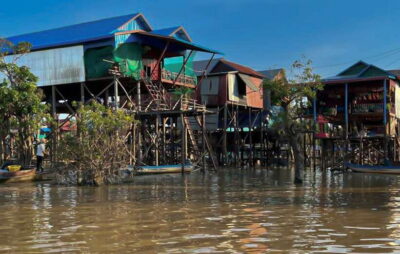
Kampong Phluk Floating Village Tour with Boat
Read our review →
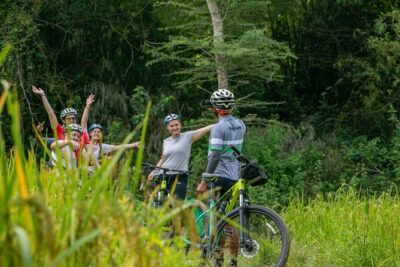
Siem Reap Countryside Bike Tour / E-Bike or Tuk Tuk
Read our review →
Tonle Sap, Kampong Phluk & Floating Village Tour
Read our review →
Afternoon tour by tuk tuk to bamboo train,bat cave,killing cave,countryside.
Read our review →
Browse the lists this tour appears in